How Damian Hall Reduced his Biological Age
Damian Hall, 50, is a renowned British ultrarunner, known for running records on the Pennine Way and South West Coast Path. His third running book, Run Forever, is out now and his UK speaking tour runs from April to May.
This September, Damian will take part in the 2 Valleys Trail, following his participation in the SwissPeaks 380 race. Here, he shares how he reduced his biological age by 30 years with his training approach and mentality.
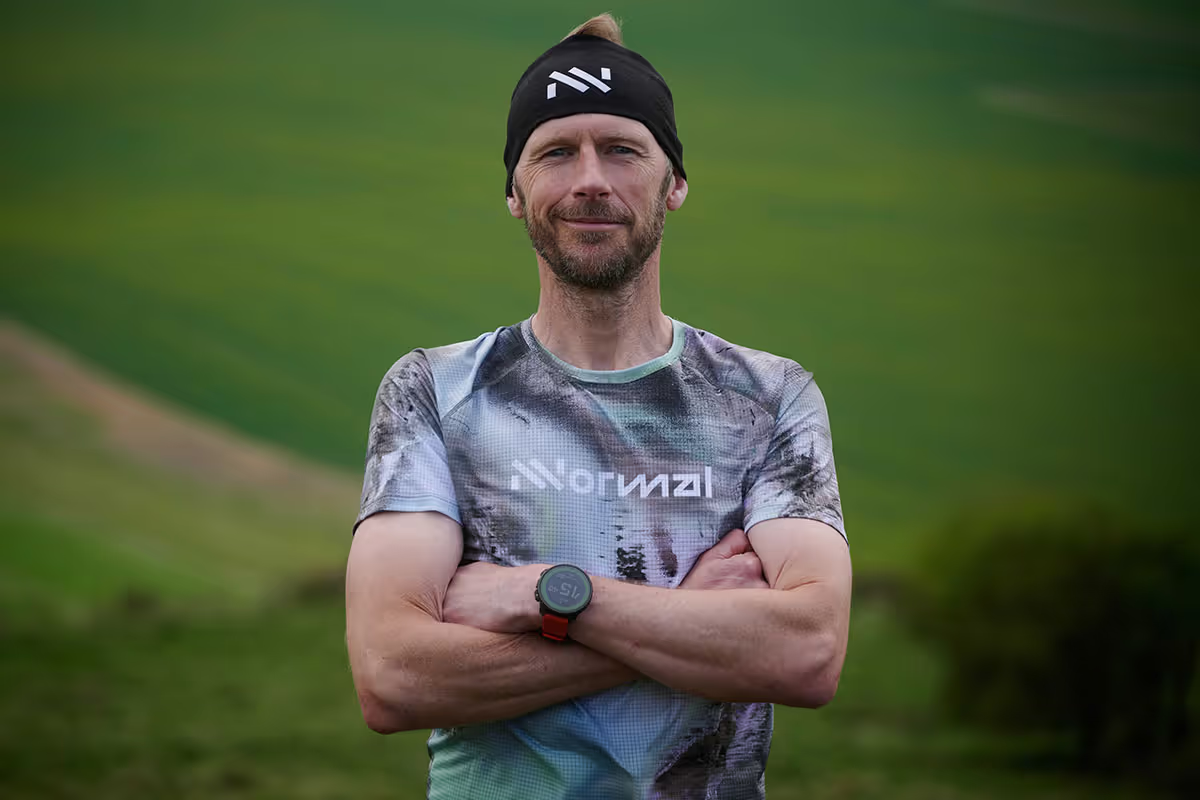
Image: Runners World @lukejarmey
I just had one of those birthdays with a big ominous ‘0’ at the end of it, screaming, ‘You’re past your best, you slow and feeble, wrinkly-bottomed has-been (and get an age-appropriate haircut while you’re at it)!’ Or did my kids say that? My memory isn’t as good as it was.
There was cake, tea and a bimble. So, like a normal day, really. Except I had friends joining me. I’d picked mostly slightly older ones, to make myself feel younger. But they mostly mocked me nonetheless, for the same things as my children. It’s a cruel world out there. And it gets crueller with age.
While it was lovely to celebrate, reaching 50 is, well, disappointing. A parkrun lifetime PB is very unlikely now, while recovery from races and workouts takes longer and I just feel more tired. I promise not to mention it every single issue, but I’ve been writing a book about ageing as a runner and the psychological side of it is shocking.
Several studies, with different designs, in different countries, across the years, show the same thing. How we think about ageing affects how we actually age. My favourite, from Harvard in 1979, saw a group of 70-80-year-olds live for a week like they were a decade younger; they watched films, listened to music, read magazines, discussed political and sporting events and journalled, all as if it was 10 years ago.
Afterwards they improved in cognitive tests, their vision got sharper, their joints more flexible, their hands more dextrous, inflammation from arthritis receded. Related research shows the same correlation but the other way, too. If we think negatively about our chronological age (the candles on our cake), we can biologically age (how advanced senescence in our cells really is) quicker.
It’s great news for me as my Spotify is stuck in the 1990s anyway and fittingly my Suunto says I have the fitness (aka biological) age of a 20-year-old. Though that may not be actual science, in running there are so many inspiring, ageless aces out there, such as Jo Pavey, Nicky Spinks and Tommy Hughes – and I plan to join them.
While my 400m reps slow down, my dreams, ambitions and my eagerness to get on with them are only speeding up. My training is changing (more strength, less volume), but my plans are as big as ever. I fully intend to age disgracefully, attempting things a V50 has no right to do, to stick a middle finger up at age.
Hunter S Thompson was an early journalistic hero of mine and I love what he says about ageing, too: ‘Life should not be a journey to the grave with the intention of arriving safely in a pretty and well preserved body, but rather to skid in broadside in a cloud of smoke, thoroughly used up, totally worn out, and loudly proclaiming “Wow! What a ride!”’ Amen.
The original article by Damian Hall was published on runnersworld.com in March 2026. Read more here.